05 12/11
09:46

machinic bodies

Tags: , , | Categories: art, digital media

A prosthetic body is one filled with artificial parts that complete or fix dysfunctional parts of that body. Prosthesis are in the 21st century commonly found as inner replacements or enhancements that augmented the body. They are not extensions of nor autonomous from the body, though. They rather mingle with the body to the point of fusing indistinguishably from it. The prosthesis has acquired a natural character. A prosthetic body cannot be differentiated from a non-prosthetic one as the prosthesis is not externally designed. As the machine once did, today the prosthesis are lively beings.

Culturally an artificial part played the role of an unwelcome aid; and it wasn’t considered necessarily beautiful, because the were simply visible alien. Nowadays beauty has to be augmented through implants and prosthesis. Beauty is defined by the prosthesis that are usually fully integrated into the body.

Just as beauty prosthesis, the technical media are blending with our skin. Their interfaces, we operate, are as sensible as if they were actual beings. Their hardware, body, is portable and is everywhere. We carry them with us as closer as possible. We feel naked or uncompleted when they happen to be absence. These are the final steps to be inside the body, to blend the media with the body, and to take over the body. Soon we’ll be all populated by prosthesis.

02 08/11
15:48

Digital Media Morality

Tags: , , , | Categories: media

‘Become mediocre’ is the only morality that makes sense. [qtd. 1, p.22]

Now:
Become spectacular is the only morality that makes sense
Become consumed is the only morality that makes sense
Become pictured is the only morality that makes sense
Become green is the only morality that makes sense
Become transparent is the only morality that makes sense

How could then be described the morality of our days?
It is said that a healthy and progressive modern society is that one with a large middle class to produce consumption. The middle class is a vast collection of people whose social relations are mediated by consumption. These mediations are materialized in different kind of objects like images, products, and trends. Today we have a mediation of second order. The digital media have first co-opted all other channels to be informed of new trends; second they have challenged the products as mediators of social status; finally in the digital media are produced all the images of the spectacle we live in. The morality of today is shaped in the digital media. But still, how could it be described?


  1. Berman, Marshall. All that is solid melts into air: the experience of modernity. London, UK: Verso. 1983.

10 05/10
16:24

Machines fracture flows

Tags: , , | Categories: art, media

A machine may be defined as a system of interruptions or breaks.[1, p.36]

Every machine is part of system of machines and all of them integrate a constant current. This current has no starting point nor end, it is just a collection of connections that flows. Thus, a machine is perceived through the fractures it creates in a flow. The fractures frame discreet portions of the flow, therefore machines have inputs and outputs (other flows), and in the middle a particular flow is processed. If there is something to say about a machine is that it fractures a collection of flows. A machinic attitude in media must then make evident the fractures rather than to hide them.


To interrupt click over and move your mouse


  1. Deleuze, Gilles and Felix Guattari. Anti-Oedipus: Capitalism and Schizophrenia. Minneapolis, MN: University of Minnesota Press. 1983

05 06/09
18:05

The machine.

Tags: , | Categories: art, digital media

Machine

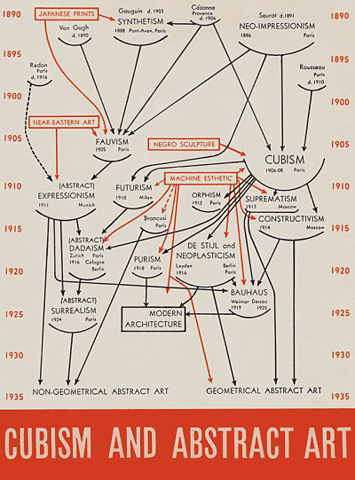
The machine in the XX century art. [3]

“I am accustomed, most of all at night, when the agitation of my soul fills me with cares, and I seek relief from these bitter worries and sad thoughts, to think about and construct in my mind some unheard-of machine to move and carry weights, making it possible to create great and wonderful things”
Alberti, Leon. Della Tranquilitiá dell’ animo. 1441 [qdt. 2, p.96]

I opened this post with two statements about the machine, separated for more than 500 hundred years. The painting addresses an aesthetic of the machine to the early XX century European art. The quote addresses the dreams of building machines to marvel others. Both are tied for a sort of machinic thought, however what a machine means for the Renaissance and to the XX century is as different as what machine means for us at the beginning of the XXI century.

The painting resembles an electric diagram, connections are drawn, and flows are set. From a machine aesthetic steams a variety of expressions that escape the representational path. One can venture an interpretation of this painting as the navigation tree for a web-site or an organization chart. Nevertheless, it presents a historical view of the western art in the manner as a machine is organised and deeply influenced by the machine as an abstract and aesthetic concept. This interpretation might be taken as technological determinism as long as the root and cause for this movements is found in the technical progress, but I will argue that it expresses rather a turn to the central role that technology has taken over other aspects of social relations to the point of overshadow them, in a critical way. For instance the programmatic understanding of constructivism and fragmented view of space of cubism.

Machines have a far impact in our live that we used to acknowledge, our version of the machine is quite different, these are not heavy mechanical apparatuses, rather are soft-machinic assemblages [1, p.211], and difficult to identify as machines. The cellphone that ubiquitous gadget is a machine we use to communicate with others regardless our location, that mini machine determines our capability to immediately reach somebody and our own reachability. But it is more than that it also provides with a myriad of other functions, play games, music, take pictures, videos, and read news. A machine that adapts to its owner desires, an open machine.


  1. Broeckmann, Andreas. “Image, Process, Performance, Machine: Aspects of an Aesthetics of The Machinic”. MediaArtHistories. Ed. Oliver Grau. Cambridge, MA: The MIT Press, 2007. 193-205
  2. Sawday, Jonathan. Engines of Imagination: Renaissance Culture and the rise of the Machine. London, UK: Routledge. 2007
  3. Wolfe, Steve. Untitled (Cubism and Abstract Art). 1997. MoMa . <https://moma.org/collection/browse_results.php?object_id=81386>
Archives